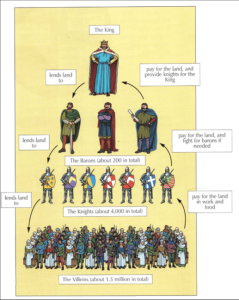
Most people are familiar with some of the titles used in Medieval England. Lord, Knight, Peasant. The first time I read a medieval biography, a pattern became clear: every man is called either Thomas, Richard, Henry or John (hence the phrase Tom, Dick and Harry). Their titles keep them apart and so not only did it make me chuckle but made me realise I’d benefit from understanding the titles’ responsibilities, rarity, status and of course power.
And so with that came questions about the feudal pyramid:
- what were their responsibilities?
- how rare were their titles?
- how did they obtain their title?
First of all it’s important to know feudalism was a social, political and economic system centered around the holding and leasing of land or fiefs.
Below I’ll take you through the levels and take you through my though process along the way.
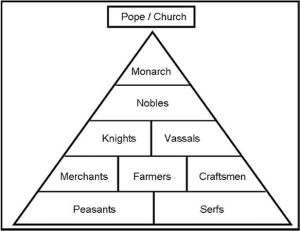
Nobles
- The King Sovereign
role:
- owned all land
- granted fiefs to nobles in exchange for loyatly, military service and taxes
- ultimate law-giver and judge
rarity:
- obviously one at a time.
- Dukes Highest rank of nobility
role:
- governed very large terrritories often near borders or unstable regions
- commanded armies
- often royal relatives or extremelt trusted magnates
rarity:
- 0-5 at once
- Marquess Border Lords
role:
- governed strategic borders, especially scotland and wales.
- responsible for defense, fortifications, and military readiness
rarity:
- rarer than dukess
- term was used late and sparingly
- Earls Counts
role:
- ruled counties/earldoms
- collected taxes
- raised troops
- administered justice locally
rarity
- 10-20 at a time
- core medieval elite
- Viscounts Deputies / Assistants Originally "vice-counts" (deputies of counts/earls)
role:
- administrative and judicial functions
rarity:
- almost nonexistent in medieval england
- more common in France
- becomes meaning in later periods
- Barons Backbone of the nobility
role:
- held land directly fromt the King
- owed military service i.e. knights, troops
- attended the king’s council (parliament-ish)
- enforced law on their estates
rarity:
- dozens to hundreds
- wide variation in wealth and power
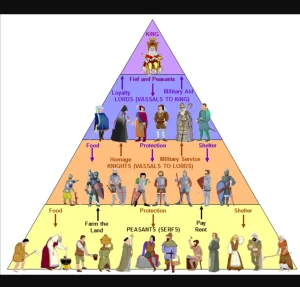
It’s key to know titles did not mean power. what mattered more was how much land you controlled. where, how many armed men you could raise and your relationship with the king. That being said the pyramid might show a structured overview however it was more a network of negotiated power.
As I learned about the lives of the Earls in [[Henry V]]’s life I wondered how one would and could become one.
Becoming and Earl comes down to land, bloodlines and royal favour. The short answer is you either get appointed Earal by the King or you inherit the title.
- Creation by the king
- The King would create and earldon and grant it to a man who had proven milkitary service, politically loyal, already held substantial land, and was unsefil to control a region.
- this was done by formal grant or ceremonial rezognition
- the title of a new ear was always from the crown.
- Inheritance
- inheritance was the most usual pathway
- passed on from father to eldest son (of course)
- if there was no mail heir it could get complicated. the title coule become extinct, fall into abeyance, or would be regranted by the king.
- good news: although women could rarely inherit the title of earl, they could inherit the land itself.
Fun fact: the word sandwich comes from the Earl of Sandwich who around 1762 wanted to eat some cold meats at his desk however working on political papers and therefore asked for his meal to be put between two pieces of bread to avoid greasing his hands. This lead to others ordering "the same as Sandwich"